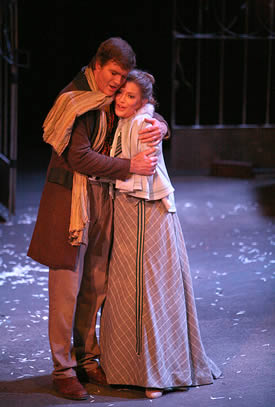
 Left - Roy Best as Rodolfo and Alison Rae Jones as Mimi. Cover - Angela Taylor as Musetta with cast
In some ways, La Bohème is an opera-lover’s opera, with all the traditional hallmarks that can make this art form seem inaccessible. It tells the tale of a group of starving Parisian artists: their passionate loves, small triumphs and many losses. But the great thing about Puccini’s opera is that it delivers its love and tragedy with plenty of humour, beautifully drawn characters and music that’s well worth the price of admission.
Opera is as much about strong acting as it is strong voices, and director Hugh Halliday and his cast clearly understood this. Our hero is Rodolfo, a poet, who falls for his neighbour Mimi, a beautiful girl with a worrying cough. Roy Best added a twist to this conventional operatic hero by making Rodolfo a slightly shy and fidgety character. This may have been off-putting for some, but it fit with the idea of the destitute poet working away in his freezing garret. Danielle Calder’s Mimi was very easy to fall in love with – an essential quality for this tragic tale to work. Mimi and Rodolfo’s dreamy, mournful courtship is complemented by the passionate tempers of their friends Marcello and Musetta. Phillip Calcagno was in danger of stealing the show with his charismatic Marcello, while Angela Taylor’s Musetta had the same hypnotic effect on the audience as she did on her many suitors.
These four parts form the backbone of La Bohème, but the supporting roles were never forgotten. Laurence Meikle was extremely likeable as musician Schaunard, as was Graeme Russell as philosopher Colline. Even Roger Howell brought humour and charm to the roles of Rodolfo’s landlord and Musetta’s sugar-daddy. Importantly, everyone from Rodolfo and Mimi down to the chorus seemed to be enjoying themselves immensely.
The vocals, for the most part, were difficult to fault, though there was one exception. Best’s voice, beautiful though it was, simply didn’t carry above the sound of the orchestra much of the time. This was particularly obvious in his scenes with Marcello and the boys, when Best was all but drowned out by the stronger singers. Thankfully, there were few other problems. It was a treat to listen to Calcagno’s confident baritone, Calder’s sweet, lilting soprano, Taylor’s impressive high-notes and the professional unison of the cast as a whole. Conductor Greg Hocking and the Melbourne Opera Orchestra also did a wonderful job of bringing Puccini’s score to life.
The production looked the part, with simple sets and costumes that evoked 1830’s Paris without intruding on the action. This relatively small opera company, while it may be working within the constraints of a tight budget, didn’t let us down in any of the visual aspects of the production.
You could argue that the measure of a good La Bohème is whether that final scene gets your tear ducts working. This production delivered on that score, and it’s possible even those who had been dragged to the theatre by their loved ones were pretending to have something in their eyes. We were left with a reminder that the South East Regional Touring Opera will be back in November with Mozart’s The Marriage of Figaro, prompting more applause from the crowd.
SERTO/Melbourne Opera presents
La Boheme
Puccini
Venue: Canberra Theatre
Date/Time: 7:30pm, Saturday 5 April 2008
Duration: 150 minutes, including intervals.
Prices: $55.00 - $20.00
www.canberratheatre.org.au
Canberra Reviews
La Boheme | SERTO/Melbourne Opera
- Details
- Alice Allan
Most read Canberra reviews
The Jungle and the Sea | Belvoir St Theatre
The Jungle and the Sea is one of the best pieces of theatre I have ever seen.
Middle Raged | Women with Pockets and Andrew Kay & Associates
Beautiful voices across the board, a lovely ease with one another, and enough self-awareness to never let the comedy become caricature.
Steel Magnolias | Neil Gooding Productions and Woodward Productions
About ten minutes in I realised I hadn't thought about the film once. I'd assumed I'd spend the whole night comparing the two, but I just ... didn't.
Diamond | Liz Lea
There are artists who make work, and there are artists who build communities. Liz Lea has spent more than three decades doing both.
Mettle | Quantum Leap Australia
I left completely captivated. And actually shaking from the joy of the experience – for me that’s a sure sign of something great.